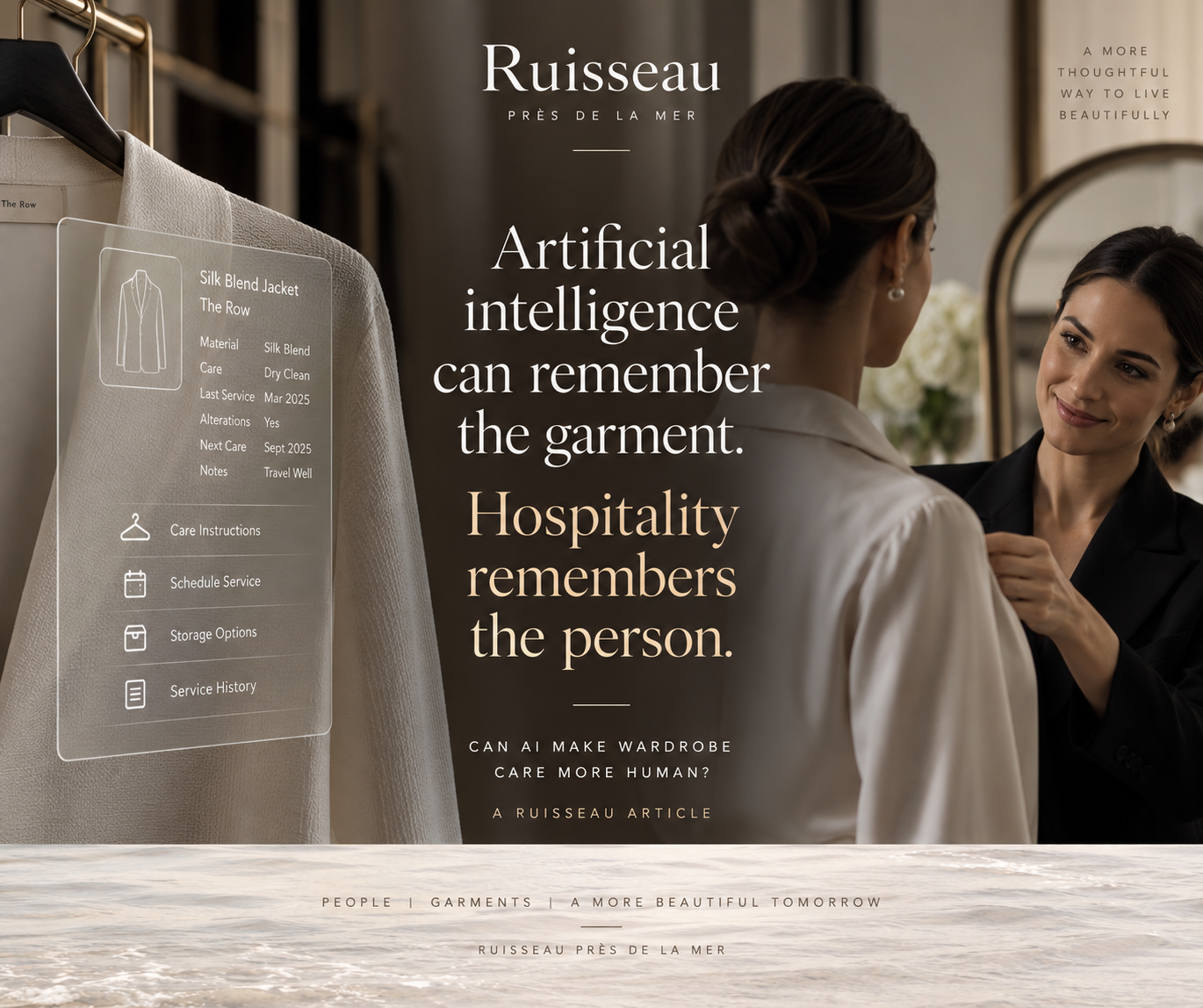
What happens when artificial intelligence isn’t used to replace hospitality, but to create more room for it?
Artificial intelligence is increasingly entering the luxury conversation.
Can AI recommend what we should buy? Predict what we might want? Personalize our shopping experiences? Coordinate services? Become a digital concierge?
But perhaps there is another question worth asking:
Can AI make luxury more human?
It sounds contradictory.
Technology is associated with automation. Hospitality is inherently associated with people. One is built around efficiency and information; the other around anticipation, recognition, discretion, care and human connection.
Yet the future of luxury may depend less on choosing between the two and more on determining what each should be responsible for.
Nowhere is that opportunity more interesting than in our wardrobes.
Luxury Has a Friction Problem
Luxury has spent generations perfecting the moment of acquisition.
The boutique.
The craftsmanship.
The presentation.
The packaging.
The associate who knows the collection.
But ownership continues long after the purchase.
A beautiful garment eventually needs cleaning. A suit may need tailoring. Shoes need maintenance. Handbags require care. Clothing needs organizing and storing. Someone may need a stylist before a business trip, hair and makeup before an event, or alterations before an important occasion.
Suddenly, the beautifully orchestrated luxury experience becomes fragmented.
One provider handles tailoring. Another handles garment care. Another handles shoes. Another handles styling. Others handle hair, nails and makeup.
And the person receiving all of these services becomes responsible for coordinating them.
That does not necessarily feel luxurious. And it certainly does not feel like hospitality.
There is evidence that the broader luxury experience is already struggling with this kind of discontinuity. Boston Consulting Group’s 2025 Luxury CX and AI Global Survey found that 56% of respondents were not satisfied with their luxury-shopping experience. BCG reported frustrations including repeatedly entering personal information, not feeling recognized by advisors and receiving impersonal or incongruous post-purchase engagement.
That suggests the challenge facing luxury is not simply access.
It is continuity.
What happens after someone leaves the boutique?
What happens when something needs care?
And who remembers what happens next?
What If Your Wardrobe Could Be Understood?
Most wardrobes contain information that exists almost entirely inside their owner’s head.
Which tailor altered that jacket?
How should that silk blouse be cleaned?
When were those shoes last repaired?
Which stylist created that look?
Which garments travel well?
Which pieces require seasonal storage?
Which handbag was recently restored?
Which gown should be preserved after an event?
Individually, these may seem like small details.
Collectively, they represent the history of a wardrobe.
Artificial intelligence creates an interesting possibility: what if the customer did not have to repeatedly remember, reorganize, search for and communicate all of that information?
AI could help interpret garment information, maintain service histories, identify care requirements, surface preferences, coordinate appointments and provide professionals with relevant context before a service even begins.
The technology does not need to become the person caring for the garment.
It can help the person caring for it understand it better.
Personalization Requires Memory
Some of the best hospitality experiences begin with something deceptively simple:
Someone remembers you.
Your preferred room.
Your favorite table.
How you take your coffee.
Why you are visiting.
A request you made during your previous stay.
These moments feel personal because the relationship does not restart every time you arrive.
BCG describes an intriguing application of AI in luxury: giving client advisors access to a more complete and current “institutional memory.” AI can surface customer history and relevant personal information while handling tasks such as follow-up scheduling, allowing the advisor to concentrate more fully on the relationship.
Imagine applying that principle to wardrobe care.
A stylist could understand previous preferences.
A tailor could access relevant alteration history.
A garment-care professional could receive important care information.
A concierge could know what services have already been completed and what comes next.
The professional enters the interaction with context instead of starting from zero.
Artificial intelligence can remember the garment. Hospitality remembers the person. The future may require both.
The Most Luxurious Technology May Be the Technology You Barely Notice
When technology is designed well, customers should not spend more time managing it.
They should spend less time managing everything else.
Consider hospitality.
A hotel guest does not need to understand the technology that helped orchestrate their stay.
They simply know the reservation is correct.
Their preferences are remembered.
Their requests are handled.
The experience flows.
Hilton has described this philosophy as “stealth tech”: technology operating quietly behind the scenes so people can concentrate on being present, connecting and experiencing the moment. Its 2026 meetings research found that 67% of surveyed attendees believed AI assistance could save them time and effort for things more important to them.
That principle translates remarkably well to wardrobe management.
Instead of remembering that something needs servicing, locating the appropriate professional, scheduling an appointment, explaining the garment, coordinating pickup, tracking its progress and arranging its return, intelligent systems could help orchestrate the administrative journey.
The customer experiences less friction.
The professional receives better information.
And the technology remains where it belongs:
behind the hospitality.
What If More AI Created More Opportunity for Human Service?
Much of the conversation surrounding artificial intelligence begins with replacement.
Which jobs will AI perform?
Which tasks will disappear?
Which professionals will become unnecessary?
Luxury gives us reason to ask something different:
What if AI gives professionals more opportunity to be professionals?
McKinsey’s 2026 research on AI and luxury identifies an important boundary between automation and human judgment.
Consumers in its luxury sample showed greater comfort with AI involvement in discovery, selection and transactions than in care, where reassurance, service and relationship stewardship become more important.
McKinsey summarizes the principle particularly well:
“The autonomy lies in reducing friction; the authority remains in preserving judgment.”
That distinction matters enormously in wardrobe care.
A system can coordinate an appointment.
It cannot replace the eye of an exceptional tailor evaluating how a garment sits on someone’s body.
AI can surface previous styling preferences.
It cannot fully reproduce the conversation between a stylist and a client preparing for an important moment.
Technology can maintain the history of an heirloom garment.
It cannot understand what that garment means to the family preserving it.
AI can organize information. A professional interprets nuance.
AI can identify patterns. A professional exercises judgment.
AI can create efficiency. A professional can create an experience.
Perhaps the future of AI in wardrobe management should not be measured by how many people technology can remove from the process.
Perhaps it should be measured by how much more time it gives those people to care.
Hospitality Still Requires Humans
The research outside luxury points toward the same conclusion.
A 2026 systematic review published in Technology in Society synthesized 61 peer-reviewed studies on customer adoption of AI-enabled hospitality services.
The researchers found that consumers tend to embrace AI for routine and enjoyment-oriented tasks while continuing to prefer human interaction in complex or emotionally charged situations.
That distinction should influence how we design AI for luxury.
Scheduling a pickup is one thing. Handling a damaged couture garment is another.
Sending a service reminder is one thing. Helping someone prepare for their wedding is another.
Providing basic care information is one thing. Deciding what should happen to an irreplaceable heirloom is another.
The goal should not be automation everywhere simply because automation is possible.
The goal should be knowing where technology belongs—and where humanity matters more.
Deloitte’s 2026 luxury research reaches a similar conclusion, describing leading hospitality and retail innovators as using “AI to handle the predictable so humans can own the memorable.”
That may be one of the clearest descriptions of what responsible AI in luxury should accomplish.
Even the Garment Is Becoming More Digital
Another transformation is happening quietly.
The physical objects inside our wardrobes are beginning to acquire richer digital identities.
Under the European Union’s Ecodesign for Sustainable Products Regulation, textile apparel is a priority category for future Digital Product Passport requirements.
The European Commission says these passports are intended to make relevant product information more accessible and comparable throughout a product’s lifecycle, supporting transparency and circularity.
The initiative is regulatory and sustainability-focused—it is not the same thing as personal wardrobe management—but it signals something important.
The relationship between physical garments and digital information is becoming deeper.
Imagine what becomes possible when information surrounding an item—its composition, care, maintenance, service history and lifecycle—can become useful throughout ownership.
The wardrobe stops being simply a collection of physical objects.
It begins becoming an ecosystem of physical objects surrounded by intelligence.
The Digital Closet™
At Ruisseau près de la mer, we have been thinking deeply about this intersection.
We define wardrobe more broadly than clothing alone.
A wardrobe is everything that helps express who you are—from clothing, shoes, handbags and jewelry to hair, nails and makeup.
Managing that world currently requires relationships with multiple professionals, businesses, appointments and systems.
We do not believe the customer should have to become the coordinator of all of them.
That philosophy led us to the Digital Closet™: the digital home for a person’s wardrobe.
The goal is not to build technology that replaces stylists, tailors, garment-care professionals, beauty professionals or concierges.
Quite the opposite.
We believe technology should help connect the ecosystem surrounding the customer so those professionals can deliver better-informed, more personalized service.
AI can help organize.
It can help remember.
It can help anticipate.
It can help coordinate.
But when the moment calls for craftsmanship, judgment, conversation, reassurance, discretion or care, there should still be a person.
Because our vision of the future is not hospitality without humans.
It is technology sophisticated enough to give humans more opportunity to deliver hospitality exceptionally.
So, Can AI Make Wardrobe Care More Human?
Perhaps.
But only if we design it to.
The wrong question may be whether artificial intelligence can replace the people who care for our wardrobes.
The better question is whether AI can remove enough friction that those people have more opportunity to do what technology cannot:
Know us. Anticipate us. Understand us. Care for us. Make us feel considered.
The future of wardrobe care may become dramatically more technologically sophisticated.
But if we build it correctly, perhaps the technology itself will become almost invisible.
What remains visible will be the experience.
The craftsmanship.
The attention.
The relationship.
The hospitality.
And paradoxically, the more intelligent our wardrobes become, the more human caring for them could feel.
Research & Further Reading
- Boston Consulting Group — Why the Luxury Experience Needs an AI Moment (2025)
- McKinsey & Company — When AI Meets Desire: Innovating Human-Centered Luxury Experiences in the Agentic Age (2026)
- Deloitte — Future of Luxury Marketing (2026)
- Blüher et al., Technology in Society — Human Touch in the Age of AI: Customer Willingness to Adopt AI-Enabled Hospitality Services (2026)
- European Commission — Textile Apparel and the Digital Product Passport
- Hilton — 2026 Trends Report: Why We Gather